Over the past year, Malaysia has witnessed a series of deeply troubling incidents involving students within physical campus and campus-related environments.
Among them:
• A student found dead in off-campus accommodation
• Violent assaults involving students within learning premises
• Casualty and serious injuries caused by infrastructure and facility failures
• Fatal accidents linked to shared physical learning spaces
• Crimes occurring during late-hour campus activities and student housing
These are not rumours.
They are reported tragedies.
And while each incident has its own circumstances, they share one uncomfortable truth:
They all happened because learning required physical presence.
Traditional higher education systems were built on the assumption that learning must occur in centralised, crowded and often loosely monitored physical spaces. That assumption made sense decades ago. Today, it introduces avoidable risk.
This is why Open and Distance Learning (ODL) and structured online learning are no longer optional alternatives.
They are the way forward.
ODL does not weaken education.
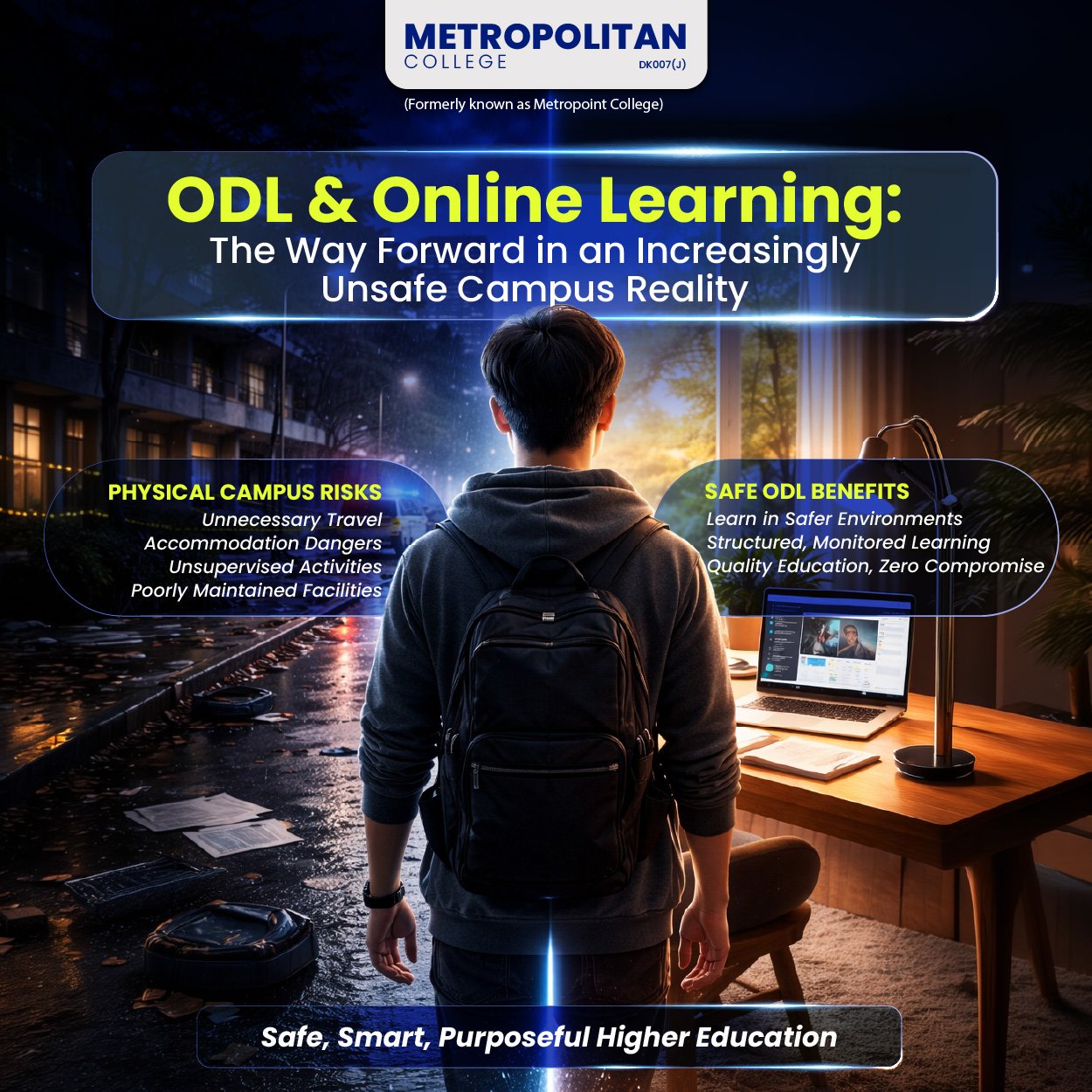
It removes unnecessary exposure to risks that have nothing to do with academic quality, including:
• daily commuting and late-night travel
• high-risk off-campus accommodation
• ageing or poorly maintained facilities
• unsupervised after-hours campus presence
• uncontrolled congregation of young adults
With properly designed ODL:
• learning happens in safer, familiar environments
• engagement is tracked via LMS platforms
• content is delivered through structured Self-Instructional Materials (SIM)
• academic standards remain intact without physical dependency
This is not about eliminating campuses.
It is about recognising that physical presence should be purposeful, not automatic.
The real question institutions must confront is simple:
Why are students still being exposed to risks that are unrelated to learning outcomes?
ODL and online learning are not just about flexibility or access anymore.
They are about designing education systems that protect students by default.
The future of higher education is not only digital.
It is safer, smarter and intentional.
This is also why institutions such as Metropolitan College have placed strong emphasis on structured Open and Distance Learning (ODL) programmes designed to deliver quality education without exposing students to unnecessary physical risk.
Metropolitan College’s ODL programmes are built on structured learning frameworks that include guided Self-Instructional Materials (SIM), monitored engagement through Learning Management Systems (LMS), and academic oversight by qualified lecturers. These programmes ensure that students receive the same academic rigour, learning outcomes, and recognised qualifications without the need for constant physical presence.
More importantly, these programmes reflect the evolving realities of modern education and student safety. They provide access to quality, recognised diploma and degree pathways while allowing students to learn in controlled, safer environments, whether at home or in structured learning centres.
This approach is particularly relevant in today’s environment, where safety, accessibility, flexibility, and educational continuity must coexist. ODL is no longer merely an alternative delivery mode. It is a forward-looking model that aligns education with the realities of modern risk, technology, and student needs.
Institutions that embrace structured ODL are not lowering standards.
They are strengthening education by removing risks unrelated to learning.
The future belongs to institutions that design education not just for knowledge delivery but for student protection, accessibility, and sustainability.
Written by:
Luke Halim
Founder and Lead Consultant
The Learning Standard and The Leading Standard