Lecturers have long been the cornerstone of higher education. This remains reflected in current MQA requirements which emphasise the appointment of qualified academic staff to support programme delivery, governance and quality assurance.
That foundation is not in dispute.
What deserves reconsideration is how lecturer roles are operationalised in today’s learning environment, particularly within Open and Distance Learning (ODL) and technology-enabled models already recognised under COPPA ODL.
From an institutional operations perspective, fully human-dependent delivery models present recurring challenges.
Institutions routinely manage:
• Teaching disruptions due to MCs and ELs
• Absences arising from family-related responsibilities, including elderly care and bereavement
• Last-minute class cancellations or postponements
• Inconsistent delivery when replacement lecturers are not immediately available
• Student dissatisfaction and complaints caused by interrupted learning continuity
These are not issues of commitment or professionalism.
They are reminders that lecturers are human beings not machines.
At the same time, student expectations have evolved. Learners increasingly expect continuity, predictability and on-demand access particularly in flexible and ODL settings.
AI-enabled and technology-supported learning systems already permissible within MQA-recognised frameworks, are now capable of:
• Delivering standardised content aligned to CLOs and PLOs
• Supporting self-paced, student-centred learning
• Ensuring continuity regardless of individual availability
• Reducing operational risk caused by unforeseen disruptions
This raises an important question for institutions and policymakers:
If learning outcomes, assessment integrity and academic standards can be assured through structured, technology-enabled delivery, should regulatory emphasis remain primarily on traditional content-delivery roles or evolve towards learning assurance and academic oversight?
This is not an argument to remove lecturers from higher education.
Rather, it is a call to reposition academic value:
• Less emphasis on repetitive content delivery
• Greater emphasis on facilitation, mentoring and critical engagement
• Stronger focus on assessment governance, ethics and academic judgment
• Clearer roles in curriculum stewardship and quality assurance
As delivery models evolve, the number of lecturers required for delivery may change.
However, the need for academic leadership and scholarly oversight remains essential.
At The Learning Standard, we believe the future of higher education lies in resilient, MQA-compliant systems where technology ensures continuity, scaling and consistency, while human academics contribute where judgment, ethics and values matter most.
This direction is already reflected in the structured ODL and technology-enabled programmes offered by Metropolitan College.
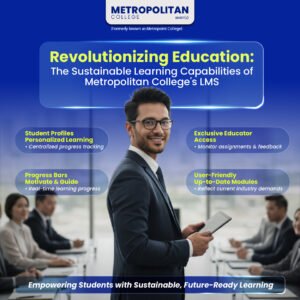
Metropolitan College’s programmes are designed around structured Self-Instructional Materials (SIM), LMS-based engagement tracking, and guided academic oversight, allowing content delivery to occur consistently regardless of individual lecturer availability. This ensures that students receive uninterrupted learning aligned with programme learning outcomes, while academic staff continue to play critical roles in mentoring, assessment, academic governance and quality assurance.
Rather than positioning lecturers solely as content deliverers, Metropolitan College’s model aligns with the evolving role of academics as facilitators of learning, custodians of academic standards, and providers of intellectual and ethical oversight. Technology supports delivery continuity and scalability, while lecturers provide academic judgment, contextualisation and student guidance where human expertise is indispensable.
This approach reflects the natural evolution of higher education under MQA-recognised ODL frameworks. It strengthens institutional resilience, improves student learning continuity, and ensures that academic resources are focused where they add the greatest value.
In this model, technology does not replace lecturers.
It enables lecturers to fulfil their highest and most important academic functions.
The future of higher education will not be defined by how often lecturers deliver content.
It will be defined by how effectively institutions combine technology-enabled delivery with strong academic stewardship.
Written by:
Luke Halim
Founder and Lead Consultant
The Learning Standard and The Leading Standard